Back
How Long Google Can Take to Crawl, Index and Recover Your Site
- 14 Oct 2026
- |News
- |Posted by Martyn East
How long does SEO take?
Google finds new pages within about a day, but it can take weeks, months or even more than a year for changes to a site to be fully reflected in search results. That’s the clearest message from timelines Google shared at a recent Search Central event.
If you’ve ever wondered why SEO work doesn’t produce results overnight, these figures explain it. Google spots new pages quickly, but it doesn’t check back on existing pages very often. When we improve a site, Google has to revisit it, process the changes and then decide whether the site deserves to rank higher. Each of those steps takes time, and bigger changes take longer to be trusted.
Key takeaways
- Discovery is fast, re-evaluation is slow. New pages are usually found within a day, but Google typically revisits existing pages only around every 30 days.
- Bigger changes take longer to be trusted. Migrations usually take 1–3 months to settle and can take over a year; core update recovery usually takes 3–6 months.
- Some recoveries wait for the next core update, however good the fixes are.
- You can speed things up at the edges with clean crawlability, accurate sitemaps, strong internal linking and requesting indexing for key pages.
- Quality is what earns lasting rankings. Focus on helpful content and user value, then give Google time to recognise it.
- Judge SEO over months, not days. Steady, consistent work compounds over time.
How Google finds, understands and serves your content
Every page has to pass through three stages before it can appear in search: crawling, indexing and serving. A delay at any one of them pushes back when you see results.
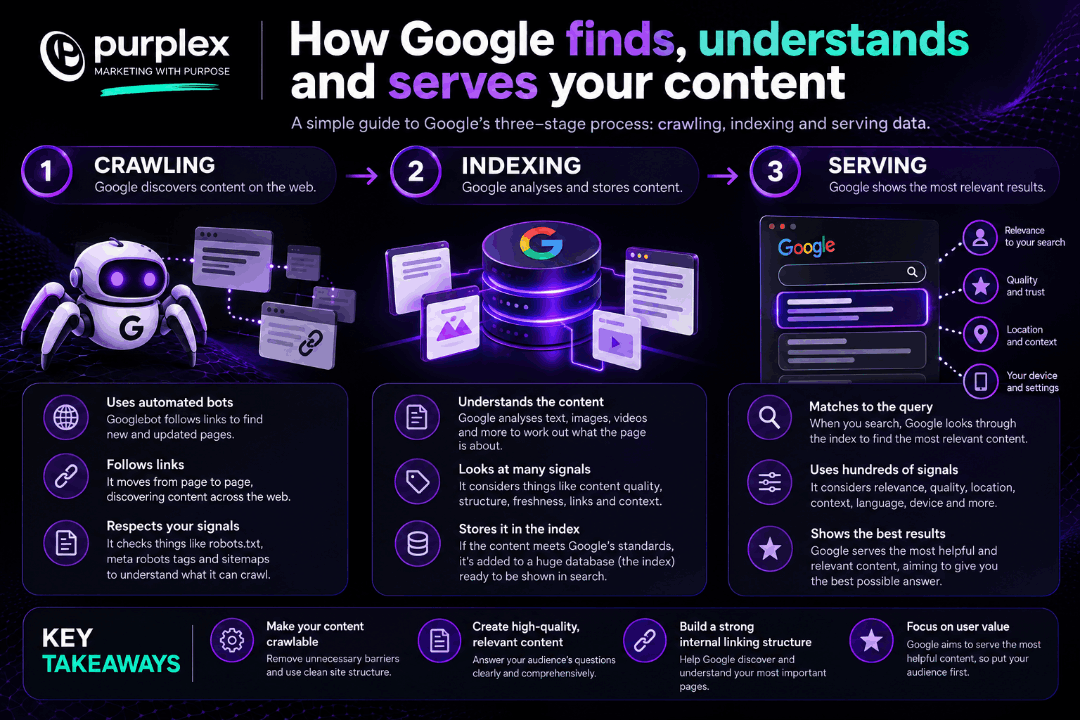
- Crawling. Googlebot, Google’s automated crawler, follows links from page to page to discover new and updated content. It respects the signals you give it, such as robots.txt, meta robots tags and XML sitemaps.
- Indexing. Google analyses the text, images and video on a page to work out what it’s about, weighing signals such as quality, structure, freshness and links. If the page meets Google’s standards, it’s stored in the index, ready to be shown in search.
- Serving. When someone searches, Google looks through its index and ranks the most relevant, helpful results, taking into account the query, location, language, device and hundreds of other signals.
How long it actually takes
The bigger the change, the longer Google takes to process it and trust it. These are the typical timelines Google shared at the event:
| Scenario | Typical timeline | Why |
|---|---|---|
| New pages | Usually found within about a day | Google is quick to discover fresh URLs, especially on sites it crawls often |
| Updates to existing pages | Weeks; Google typically revisits pages around every 30 days | Improvements only count once Google re-crawls and re-processes the page |
| Site migrations | Usually 1–3 months to settle; sometimes 6 months to over a year | Google has to recrawl old and new URLs, follow redirects and transfer signals |
| Recovering from a core update | Usually 3–6 months; some sites won’t recover until the next core update | Google needs to reassess the whole site’s quality, not just individual pages |
There are nuances. Large, frequently updated sites tend to be crawled more often, while smaller or rarely updated sites may wait longer. But the overall pattern holds: discovery is fast, re-evaluation is slow.
What this means for your business
SEO results build gradually, so it pays to judge progress over months rather than days. Here’s how that plays out in practice.
- New content can show early signs quickly. A new service page or blog post may be indexed within a day, but ranking well usually takes longer as Google gathers signals about it.
- Improvements to existing pages need patience. If we rewrite a key page in week one, Google may not revisit it for several weeks, and the ranking effect can take longer still.
- Website rebuilds need careful planning. A migration done well can still take one to three months to settle. Done badly, without proper redirects, it can cost rankings for much longer.
- Recovery isn’t instant. If your traffic dropped after a core update, fixing the underlying issues is only the first step. Google has to reassess your site, and sometimes the full benefit only shows at the next core update.
This is why we report on trends over time and set expectations at the start of every campaign. A quiet first few weeks doesn’t mean nothing is happening.
How we help Google pick up your changes faster
You can’t force Google’s timelines, but you can remove the obstacles that slow them down. These are the optimisations we prioritise for clients.
Make your site easy to crawl
- Keep an accurate XML sitemap. Include only live, indexable pages and keep the last-modified dates honest, so Google knows which pages have genuinely changed.
- Check robots.txt and meta robots tags. A single misplaced “noindex” or blocked folder can stop important pages being crawled or indexed at all.
- Fix broken links and redirect chains. Every dead end or extra hop wastes crawl effort and dilutes signals.
- Improve site speed and server reliability. Slow or error-prone servers can cause Googlebot to crawl less.
Strengthen internal linking
- Link to new and updated pages from strong existing pages. Googlebot discovers content by following links, so pages linked from your homepage or popular content are found and revisited sooner.
- Avoid orphan pages. A page with no internal links pointing to it is hard for Google to find and suggests it isn’t important.
- Use descriptive anchor text. It helps Google understand what the linked page is about.
Signal important changes
- Use the URL Inspection tool in Google Search Console. After a significant update, you can request indexing for key pages. It doesn’t guarantee faster ranking, but it can prompt a recrawl.
- Make meaningful updates, not cosmetic ones. Changing a date or a few words is unlikely to change how Google assesses a page. Substantial improvements to content, structure and usefulness are what count.
Plan migrations properly
- Map every old URL to its new equivalent with 301 redirects before launch, and keep them in place long term.
- Benchmark rankings and traffic beforehand so you can spot problems quickly.
- Update internal links, canonical tags and sitemaps to point at the new URLs, and monitor Search Console closely for the first few months.
Focus on quality and user value
- Create helpful, people-first content that answers your audience’s questions clearly and comprehensively.
- Show experience, expertise, authority and trust (E-E-A-T) with author details, case studies, reviews and clear contact information.
- Tidy up thin, duplicate or outdated content. Improving, merging or removing weak pages can lift how Google views the site as a whole, which is especially important when recovering from a core update.
Need help with your SEO?
Whether you’re launching new pages, planning a website rebuild or recovering from a core update, Purplex can help you set realistic expectations and build a strategy that delivers long-term growth. Get in touch with our team to talk through your goals.